Few places in sport carry the weight of history quite like St Andrews. This small coastal town in Fife, Scotland, is where golf as we know it today essentially took shape, and it remains the destination every serious golfer dreams of visiting at least once. Walking the fairways of the Old Course means walking the same ground golfers have played for over six hundred years. This article traces the history of St Andrews golf, what makes the Old Course so revered, and why it continues to define the sport to this day.
The Earliest Days of Golf at St Andrews
Golf has been played on the links at St Andrews since around 1400 AD, making it the oldest golf course in the world. The land itself was declared common ground for the people back in the 12th century, and the first written reference to golf being played there dates to a 1552 charter confirming citizens’ rights to use the links for “golfe, futeball, shuting and all games.” Golf was almost certainly being played there even earlier than this document suggests, but it stands as the earliest surviving proof.
When the King Tried to Ban Golf
Golf’s popularity at St Andrews grew so quickly during the Middle Ages that it actually became a problem for the Scottish crown. In 1457, King James II banned golf alongside football, believing the games were distracting young men from archery practice that the kingdom needed for its military. This ban, ironically, is now considered the earliest documented evidence that golf existed at all. The prohibition remained in place under successive monarchs until 1502, when King James IV, himself a golfer, lifted the ban for good.
From 22 Holes to the Standard 18
The Old Course did not always follow the 18-hole format that has since become the global standard for golf courses everywhere. It originally consisted of 22 holes, eleven played going out along the coastline and eleven played coming back toward the clubhouse. In 1764, several of these holes were deemed too short and were combined, shortening the course to 18 holes. This single change at St Andrews established the standard round of golf still used across the entire world today.
The Founding of the R&A
In 1754, a group of golfers came together in the town to form what would eventually become the Royal and Ancient Golf Club, universally known as the R&A. The club’s status was further cemented in 1834, when King William IV became patron of the St Andrews Society of Golfers, granting it official Royal status. The R&A went on to become the governing body for golf across most of the world outside the United States and Mexico, a role it still holds today, giving St Andrews genuine institutional as well as historical authority over the sport.
The Rabbit Wars: A Strange Chapter in Golf History
St Andrews’ history has not always run smoothly. In 1797, the St Andrews Town Council went bankrupt and sold the links to local merchants, who promptly turned the course into a rabbit farm. What followed became known as the “rabbit wars,” over two decades of legal and physical conflict between golfers and the rabbit merchants over use of the land. Golfers eventually won out when local landowner and golfer James Cheape of Strathtyrum purchased the links in 1821 specifically to save it for the game, a decision that arguably preserved the future of the sport’s most famous home.
Old Tom Morris and the Double Greens
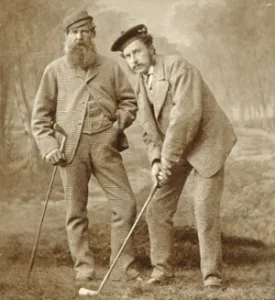
Few figures loom larger in the story of St Andrews than Old Tom Morris, often called the grandfather of golf. In 1856, Morris laid out the course’s distinctive double greens, a defining feature of links golf where two holes share a single, enormous green, present on every hole except the 1st and 18th. Morris later became Custodier of the Links under the R&A, and his influence on the course’s layout and character is still felt on every round played there today.
The Open Championship Comes to St Andrews
The Old Course hosted its first Open Championship in 1873, and it has since held the tournament more often than any other venue in the sport’s history, with the 2015 edition marking its 29th staging there. Legends of the game, including Bobby Jones, Sam Snead, Jack Nicklaus and Tiger Woods, have all lifted the Claret Jug on this same ground, a lineage of champions that adds another layer of history to every subsequent Open played at St Andrews.
Iconic Holes That Define the Course
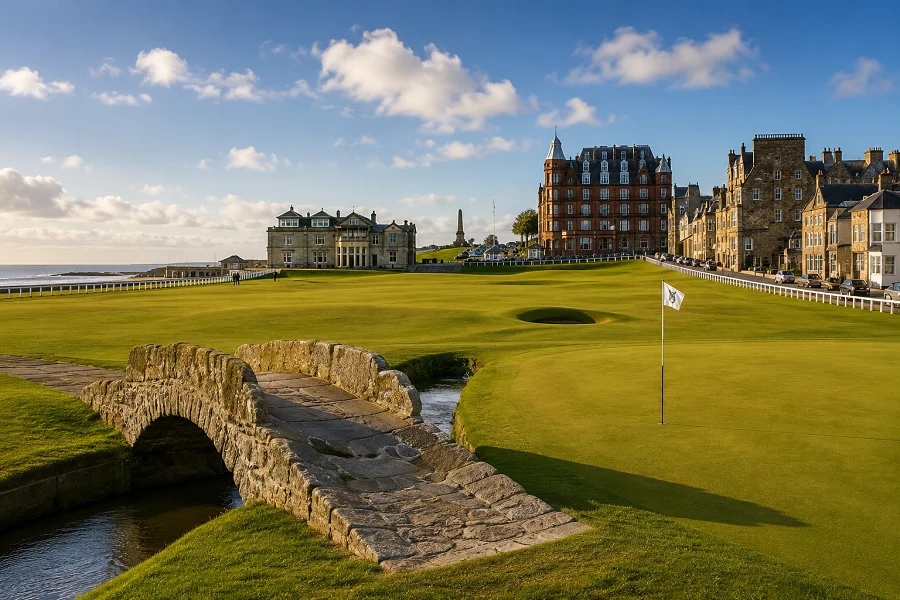
Certain features of the Old Course have become instantly recognisable throughout the golfing world. The Road Hole, the 17th, is widely regarded as one of the toughest par-4s anywhere in professional golf, while the Swilcan Bridge on the 18th fairway has become the setting for some of the sport’s most emotional farewells, including Jack Nicklaus and Tiger Woods both pausing there during their final Open Championship appearances. The massive Hell Bunker adds a further layer of genuine jeopardy to a round that already demands respect from even the finest professionals.
A Links Course Shaped by the Land Itself
Built upon a naturally formed coastal margin, the St Andrews courses owe much of their character to the landscape they sit on rather than any deliberate design choice, a defining trait of true links golf. This natural setting gives players outstanding scenery, framed by the sea and surrounding countryside, and it is this same rugged, weather-exposed terrain that shapes strategy and challenge in a way inland courses, including clubs like Selkirk Golf Club further inland in the Scottish Borders, simply cannot replicate.
Seven Courses, One Legendary Complex
What began as a single simple track through gorse and heather has grown into seven public golf courses collectively known as St Andrews Links, the largest golfing complex in Europe. Alongside the Old Course sit the New, Jubilee, Eden, Strathtyrum, Balgove and Castle courses, the last of which opened in 2008 as the newest addition. All of the courses remain open to the public, with only the Old Course requiring golfers to hold an official handicap certificate before booking a round.
Why St Andrews Still Matters
More than six centuries after golf was first played on this stretch of Scottish coastline, St Andrews remains the sport’s spiritual home in a way no other course has ever managed to replicate. Its combination of genuine historical weight, architectural influence on how golf courses are built worldwide, and its role as host to the sport’s oldest championship gives it a status that transcends any single round played there. For golfers everywhere, a visit to St Andrews remains something close to a pilgrimage.
Conclusion
From King James II’s attempted ban to Old Tom Morris’s double greens and Jack Nicklaus’s farewell on the Swilcan Bridge, the story of St Andrews is inseparable from the story of golf itself. Its six-hundred-year history, the standardisation of the 18-hole round, and its enduring role as the Home of Golf ensure that St Andrews will remain the sport’s most revered destination for generations of golfers still to come.