
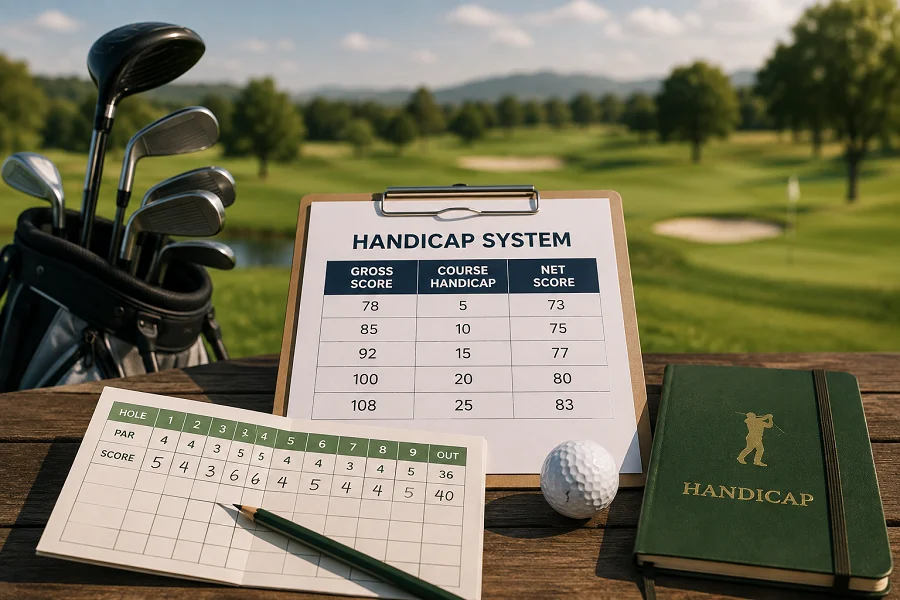
Few sports have built as elegant a solution to the fairness problem as golf. A tennis player who is simply better than their opponent wins more often, full stop. Golf, uniquely, has a built-in mechanism that lets a complete beginner and a scratch player compete on genuinely even terms in the same match, and that mechanism, the handicap system, is also precisely what makes club-level golf betting so interesting. This article breaks down how handicap systems actually work, how they interact with the classic Nassau betting format, and where genuine value hides for players willing to understand the mechanics properly.
What a handicap actually represents
A golf handicap is a numerical measure of a player’s potential ability relative to par, calculated from a player’s recent scoring history under the World Handicap System. A player with a handicap of eighteen is expected to shoot roughly eighteen strokes over par on an average day, while a scratch player, handicap zero, is expected to shoot close to par itself. The genuinely clever part is what this number then allows: when players of different handicaps compete, the higher-handicap player receives strokes on specific holes, effectively levelling the contest so that raw ability differences do not simply decide the outcome before a single shot is played.
From handicap index to playing handicap
Before any strokes are actually applied on the course, a player’s handicap index needs to be converted into a course handicap specific to the tee and course being played that day, since course difficulty varies significantly between venues. For a betting match specifically, this course handicap is then converted again into a playing handicap, calculated by comparing each player’s course handicap against the lowest in the group. The player with the lowest handicap in the match plays off scratch for betting purposes, while every other player receives strokes equal to the difference between their own course handicap and that lowest figure.
Where the strokes actually fall
Handicap strokes are not distributed randomly across a round. Every hole on a course carries a stroke index rating, from one, the hardest hole, to eighteen, the easiest, and players receive their allotted strokes starting with the hardest-rated holes first. A player receiving nine strokes in a match gets one extra stroke on each of the nine hardest-rated holes on the course, which means understanding your own stroke holes, and your opponent’s, is a genuine tactical advantage worth knowing before a betting round begins rather than discovering mid-round.
The Nassau: golf’s oldest and most enduring bet
The Nassau is the standard betting format used at clubs worldwide, and it has remained popular for over a century precisely because of how it structures risk. Rather than a single wager on the full eighteen-hole result, a Nassau splits the round into three separate bets of equal value: one on the front nine, one on the back nine, and one on the overall eighteen-hole match. A typical setup might be described as a “five-five-five” Nassau, meaning five units riding on each of the three segments. This structure means a poor front nine does not end a player’s chances for the day, since the back nine and overall match remain live bets regardless of how the first half went.
How handicaps interact with the Nassau format
Applying handicap strokes within a Nassau adds a genuine strategic layer, since strokes are typically distributed across the full eighteen holes according to stroke index, which means the front and back nine segments do not necessarily receive an even split of a player’s total strokes. A player who knows their higher-rated stroke holes cluster more heavily on the back nine, for instance, has a genuine tactical reason to play patiently through a difficult front nine, since their handicap advantage is about to become more pronounced on the second half of the round.
The press: where genuine value hides
The Nassau’s most interesting betting wrinkle is the press, an optional side bet that a trailing player or team can call when they fall two holes down with at least three holes remaining in a given segment. A press creates an entirely new bet at the original stakes, running from the current hole to the end of that nine, effectively giving the player who is behind a fresh opportunity to recover financially even if the original segment bet is already lost. Groups that play with automatic presses, where a press triggers immediately once a player falls two down, create meaningfully different betting dynamics than groups requiring an explicit call, and it is worth agreeing this rule clearly before the first tee shot rather than after a dispute arises on the ninth green.
Where handicap mismatches create genuine value
The most interesting betting value in club golf tends to appear when a player’s current handicap does not accurately reflect their present form, either because a player has been improving faster than their handicap has adjusted downward, or because a player’s handicap has crept up after a rough patch that does not reflect a genuine decline in ability. A player who understands their own group’s recent scoring trends, rather than relying purely on the official handicap index, is in a considerably stronger position to spot when a Nassau or match-play bet is genuinely favourable before the round even begins.
Course knowledge as a betting edge
Handicap systems account for a course’s overall difficulty, but they cannot fully capture the specific, local knowledge that regular members build up over repeated rounds on the same layout. Understanding exactly where a particular hole’s stroke rating undersells or oversells its actual difficulty for a specific player’s game, a long par four that suits a big hitter more than its stroke index suggests, for example, is precisely the kind of course-specific insight that separates members who consistently do well in club betting games from occasional visitors relying purely on the official numbers. This is exactly the kind of local knowledge that regulars at Selkirk Golf Club and clubs like it build up over years of playing the same layout in different conditions.
Setting sensible stakes for club betting
Whatever format your group plays, keeping stakes modest and genuinely agreed by everyone before the round begins protects the social, friendly nature that has made the Nassau popular for well over a century. A five or ten unit Nassau keeps the competitive edge sharp without turning a friendly round into something that creates genuine financial stress for anyone in the group, and agreeing press rules and stake caps clearly before the first tee shot avoids exactly the kind of dispute that can sour an otherwise enjoyable round.
Applying similar discipline to online wagering
The same principles of understanding the true odds before committing money apply just as directly to online betting and casino gaming as they do to a club Nassau. Checking a game’s actual published odds or return figures before playing, the online equivalent of understanding your stroke holes before a match, is available through bet zard, which publishes clear game information for players who want to understand the numbers behind a game before committing real stakes to it.
Responsible betting on and off the course
Golf’s handicap system exists to create fair, competitive contests, and the same spirit of fairness is worth bringing to how you approach any betting, whether a friendly club Nassau or an online session. Set a clear budget before you begin, agree stakes openly with anyone you are playing against, and treat any winnings as a pleasant bonus rather than an expectation built into the round. If betting ever starts to feel difficult to control, free and confidential support is available. GamCare offers advice and support for anyone in the UK with concerns about their gambling behaviour.
Conclusion
Golf’s handicap system is a genuinely elegant piece of sporting design, allowing players of wildly different abilities to compete fairly, and understanding exactly how it works, from course handicap conversion to stroke index placement, gives club golfers a real edge in betting formats like the Nassau. Combined with genuine course knowledge and a clear-eyed read on current form rather than official handicap numbers alone, this understanding is what separates members who consistently do well in friendly betting games from those relying purely on luck.

